Categories
Which bid strategies do advertisers actually use, and when? Our analysis of 16,825 Google Ads campaigns reveals the most common approaches and how they vary across account types.
There’s no single right way to bid in Google Ads, but there are patterns worth knowing. Use these benchmarks to see how your bidding setup compares and decide whether it’s time to switch strategies.
Next up on the Adalysis blog: When should you switch from Max to Target bidding? Stay tuned for a breakdown of when advertisers tend to change their strategy.
About the data
This article is based on data from 16,825 search campaigns over three months in 2025. We used the same filtering criteria as in our match type study. Please see this page for the full details.
The most common bid strategies
This data represents typical, non-brand campaigns with conversions.
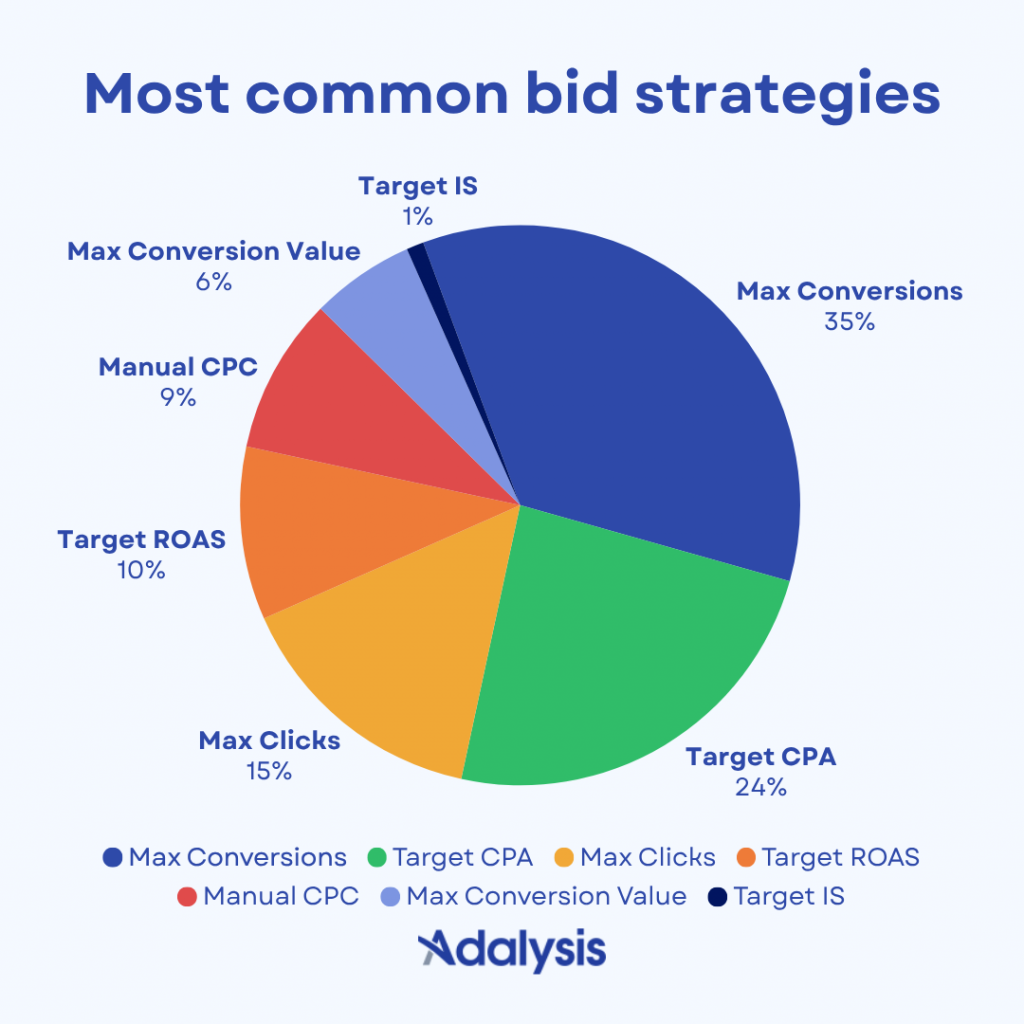
Max Conversions is by far the most common bid strategy. Most of these campaigns spend a few thousand dollars and have fewer than 10 conversions per month. This means they don’t have enough data to use a Target bid strategy. It’s an obvious choice for many advertisers.
Coming in second, Target CPA is another common strategy used by many ecommerce and lead gen companies.
Considering this data excludes campaigns without conversion data, Max Clicks bidding is surprisingly common at 15%. This strategy focuses on capturing the most clicks, regardless of their performance.
For low-volume campaigns, consider setting a quality visit as a conversion. A quality visit can be defined by an event or the amount of time spent on site. This means you can switch to Target CPA or Max Conversions bidding, which places a greater emphasis on results rather than simple clicks.
Manual CPC accounts for an unexpected 9% of campaigns, surpassing Max Conversion Value. We do have clients who automate their bidding via internal APIs or scripts. In Google Ads, those campaigns are set to manual bidding since Google isn’t making the bid changes. However, this is unlikely to make up such a large proportion of the overall data.
Campaigns without conversion data
More than 1,500 of our campaigns had no conversions in the past 90 days. Not everyone will have conversion data due to restrictions on tracking data or passing it to a third party. This is why it’s helpful to see how marketers are setting bids in this scenario.
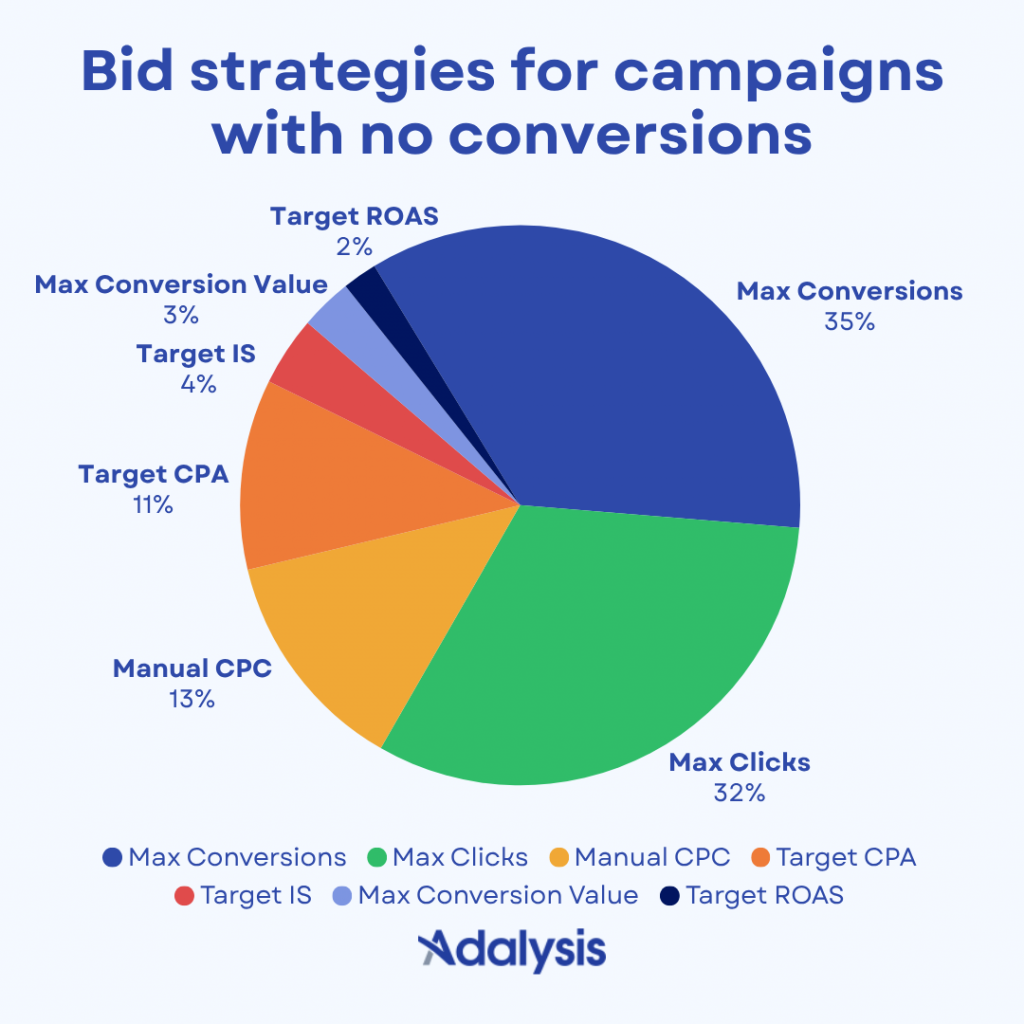
Most companies use Max Conversions. That tells us they want conversions and either aren’t getting them or their tracking is broken.
Max Clicks comes in second. If you want to automate your bidding, but you don’t have any conversion data, then Max Clicks bidding will be most advertisers’ choice. We’d still argue that you could set an interaction goal, which would allow you to use a conversion-based bid strategy for high-quality clicks.
Unsurprisingly, Manual CPC was used by 13% of these campaigns. If you don’t have conversion data and want to control your bidding, manual CPC bidding is another obvious choice.
We also see a significant increase in Target Impression Share bidding. If you want to show for a specific set of keywords and don’t have conversion data, this is an effective way to control your exposure.
These companies using Target CPA and Target ROAS need to either fix their tracking or switch bid strategies. Their bidding won’t be accurate at all.
Bid strategies for brand campaigns
Here are the most common bid strategies for brand campaigns, so you can see how they’re typically managed. It includes data from larger brands, which typically have large amounts of data. You can use this information to confirm your bidding choices or consider it as you scale your own brands.
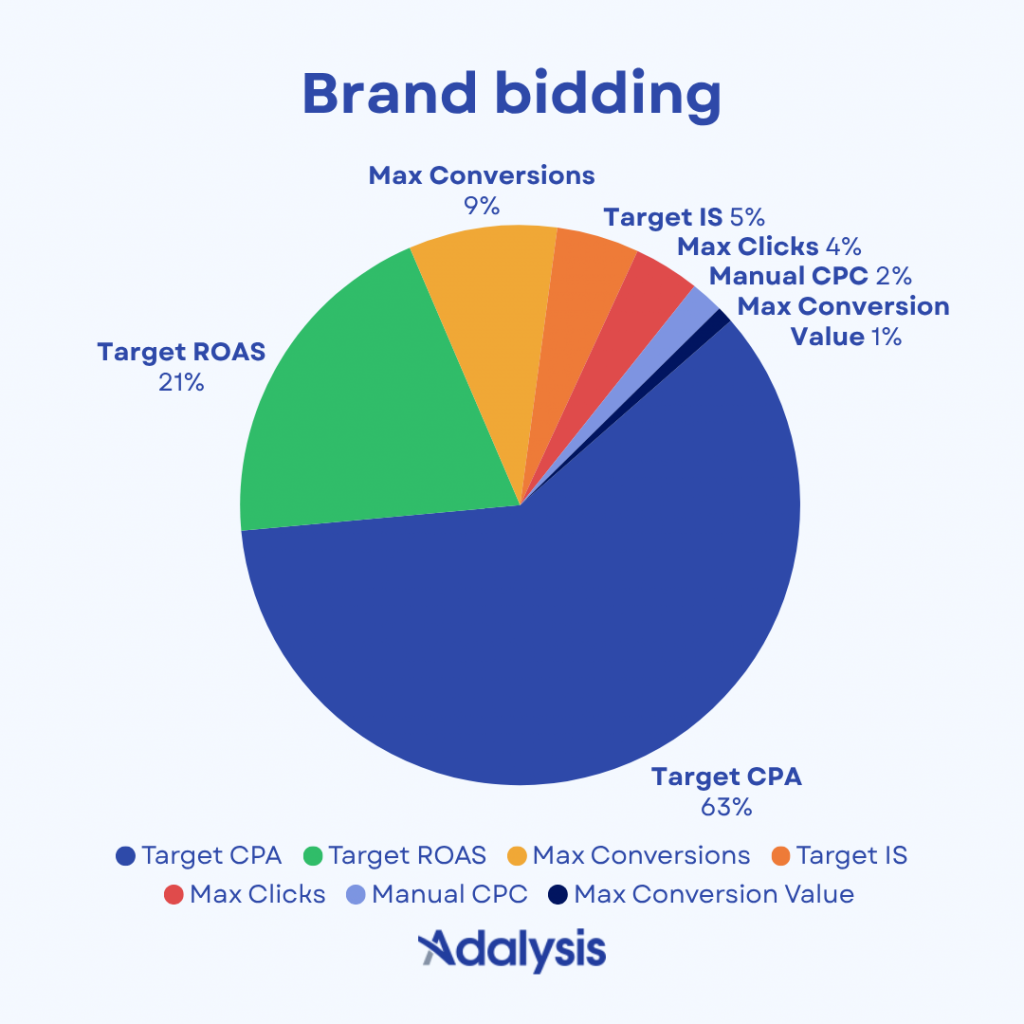
80% of brand campaigns use Target CPA or Target ROAS bidding. Advertisers spend a lot of money on their brands and want to ensure the campaigns are profitable.
While we expected the Target bid strategies to dominate this category, seeing 60% of all these campaigns use Target CPA bidding was surprising.
The only other instance where a bid strategy exceeded 50% of usage was in campaigns with over 1,000 conversions per month. This was true for brand and non-brand campaigns. Clearly, brand advertisers and advertisers with a large number of conversions prefer Target CPA bidding.
Max Conversions came in at 8% and Target Impression Share at 5%. The other bid strategies were used sporadically for brand bidding.
Why we exclude brand campaigns from most of the analysis
Brand campaigns can heavily skew the data. We exclude it as much as possible so you can focus on your non-brand campaigns.
In this table, we added the brand data to the other campaigns. The average conversions with brand data combine both brand and non-brand data.
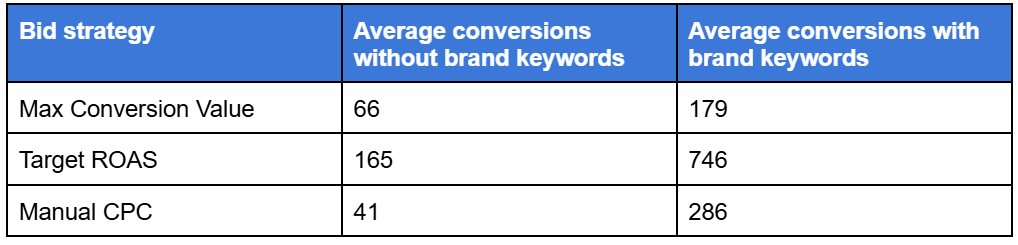
Regardless of the bid strategy, once brand data is added, average conversions increase by at least 3x. In some cases, they’re almost 7x higher. This is an illustration of how a small data set can skew a much larger one.
We always suggest segmenting brand and non-brand in both your account and your analysis.
Wrap-up
Reviewing the most common bid strategies should help you evaluate your own approach. You can then and determine which method will work best for you or consider alternatives.
- With very little conversion data, most companies use Max Clicks, Max Conversions, Manual CPC, or Target Impression Share.
- As the conversion volume increases, there’s a shift towards Max Conversions and Max Conversion Value bidding.
- With even more conversions or brand terms, most advertisers will use Target ROAS or Target CPA bidding.
The question is: at what conversion volume do you switch to a different bid strategy?
That will be the subject of our next article, providing guidance on when most advertisers switch bid strategies.
Follow us for more PPC research and insights.
Share around the web


Related posts
View all
When to pause exact match and rely on broadmatch instead
When to pause exact match and rely on broad match instead
The hidden challenges of AI Max searchterm reporting
The hidden challenges of AI Max search term reporting



Improve performance
with
actionable
analysis


This is a very clear and practical explanation of popular Google Ads bidding strategies. I especially appreciated the comparison between automated and manual bidding it helps advertisers choose the right strategy based on their goals. These insights are really useful for anyone looking to improve campaign performance. Thanks for sharing!
Leave a comment