Using search term data to inform negative keyword or new product decisions
By Brad | 1 comment October 10, 2017
Categories
Search term data is very useful information. After all, it’s what the users actually typed into a search engine. Marketers often use this data in two ways:
- Find high-converting keywords not in your account and add them
- Find non-converting keywords and make them negatives in your account
A common problem with that analysis is that when search terms don’t have many clicks, advertisers ignore them.
It makes more sense to manage low-volume queries by examining interaction rates (such as bounce rate or time on site). For instance, if a keyword has 20 clicks, it will generally get ignored. However, if you see it has 20 clicks and a 100% bounce rate, then you’ll give it less leeway before making it a negative.
However, the disadvantage of using interaction rates is that it doesn’t cover patterns across your data. It’s still just examining the actual query. This is where n-gram analysis comes in.
N-grams examine the individual word or term level and aggregate the data across all search terms using that pattern.
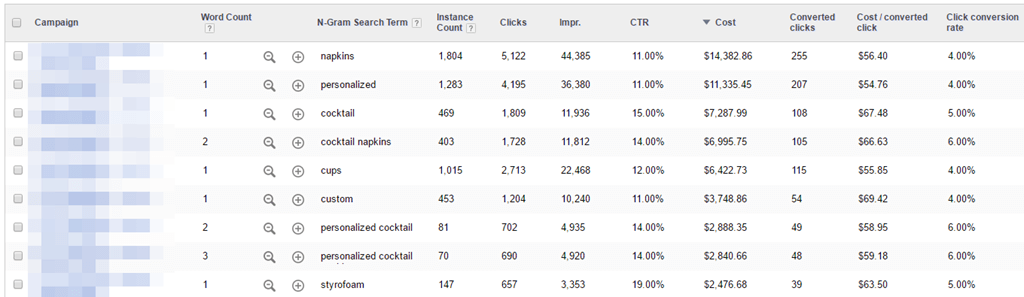
For instance, in this account, the word ‘napkins’ occurs in 1804 different queries. These search terms have a 4% conversion rate, so napkins is an important word for this advertiser.
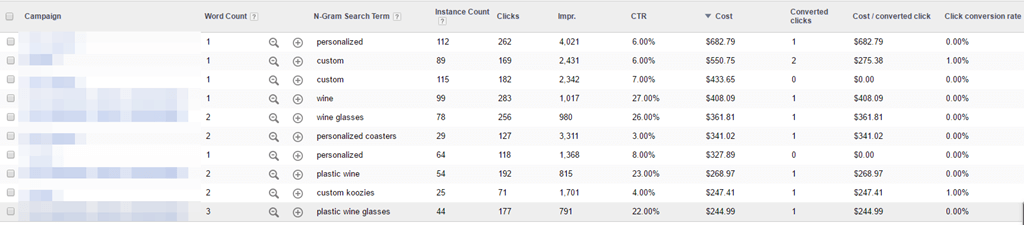
If we keep digging through high spend and low conversion words (filtering by words with less than two conversions and sorting cost from high to low), we see that the word ‘wine’ has appeared in 99 different queries. When it appears, there’s only one conversion at a very high CPA.
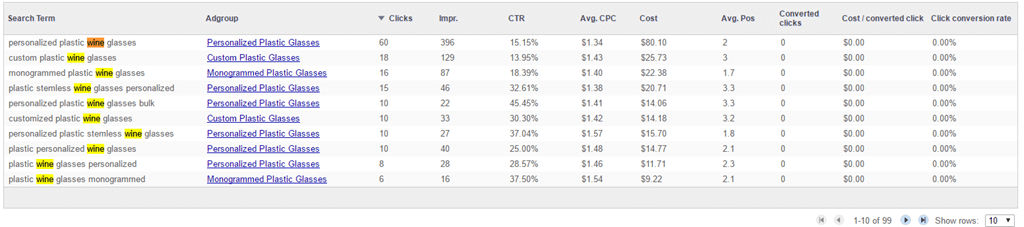
You might ask yourself why this word wasn’t spotted before and added as a negative. However, when you look at the actual search terms, none have more than 60 clicks. This shows the weakness of looking only at search terms data. You don’t spot patterns where a n-gram appears in your search terms that isn’t doing well.
At this point, we discover:
- There’s search volume for this product type
- The advertiser does not offer wine glasses
There are two options:
- Create a product to meet demand
- You might not want to make this a negative keyword. Instead, you could capitalize on the fact you can drive traffic for this category, and create a product or service
- Add this term as a negative keyword
Reviewing search terms to find negatives or new keywords is a necessary part of managing your account. However, examining search terms individually doesn’t generate many insights.
In this case, you could have added 99 negative keywords (to match 99 distinct search terms with ‘wine’) to block the traffic. However, a single negative keyword (-wine) would be more efficient, based on the root cause analysis.
Using n-grams allows you to not only find new negatives, but think about how you can expand your businesses to meet search demand.
Find out more:
- How n-grams work
- Tools for search term analysis
- N-grams from your own data, with a free trial of Adalysis
Share around the web


Related posts
View all
When to pause exact match and rely on broadmatch instead
When to pause exact match and rely on broad match instead
The hidden challenges of AI Max searchterm reporting
The hidden challenges of AI Max search term reporting



Improve performance
with
actionable
analysis


A really good post; negatives are such a powerful, yet often underused, feature of AdWords.
Leave a comment