How to automate your Google Ads KPI monitoring and make fixes fast
By Brad | 0 comments June 25, 2019
Categories
We’re a big fan of automatically monitoring KPIs and quick investigation tools for data changes.
Over the next few weeks, we’re going to dive deep into the Performance Analyzer tool (available within Adalysis or via a free Looker Studio report). This can make diagnosing KPI and data changes incredibly fast if you know the factors influencing each metric change.
Before we get into that, we want to share some survey results that show why a tool like this is so incredibly important. We surveyed 487 PPC managers about KPI monitoring, and this is what we learned.
The KPIs Being Measured
We wanted to know what type of KPIs are most commonly monitored and were surprised to find that total clicks was the number one metric, which was closely followed by total conversions, ROAS and CPA. Some companies monitored both ROAS AND CPA, but the majority of companies only tracked CPA (lead gen) or ROAS (ecommerce).
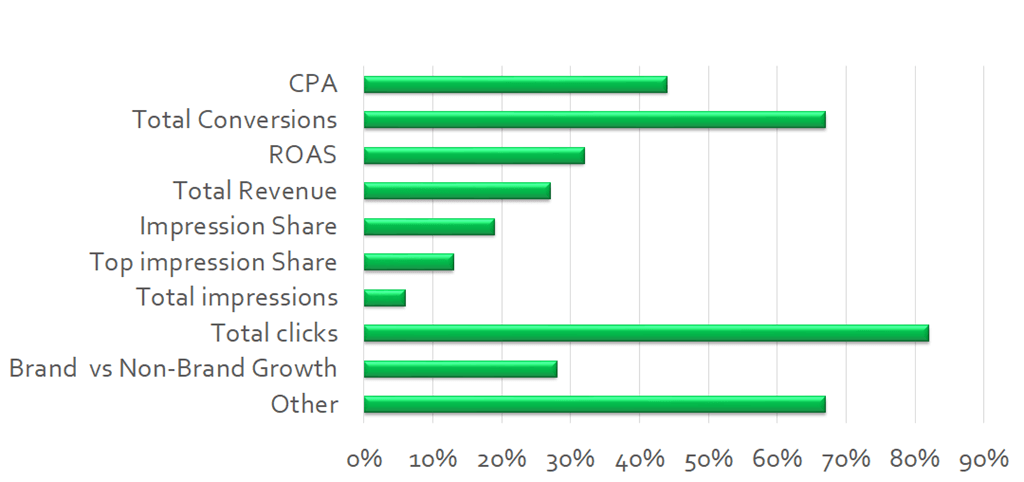
‘Other’ was a big category that gathered a lot of responses. The most common write-in was quality score, followed by spend and budgets. Surprisingly, average position was the fourth most common ‘other’ KPI being monitored.
While you could argue that quality score, budgets, and average position are not KPI metrics, if that’s what the company is measuring, then it’s something we need to make sure we can monitor.
How often do you monitor KPIs?
Once the KPIs were established, we wanted to know how often they were monitored. The most common response was monthly, followed closely by weekly. Only 11% of companies were monitoring KPIs every day.
While you might only want to monitor quality scores monthly or quarterly, monitoring your ROAS or CPA on a monthly basis seems like a bad idea. It’s so easy to automate this data on a daily or weekly basis for alerts when something drops significantly or falls below your target threshold.
When you are off target, how long does it take you to figure out why (on average)?
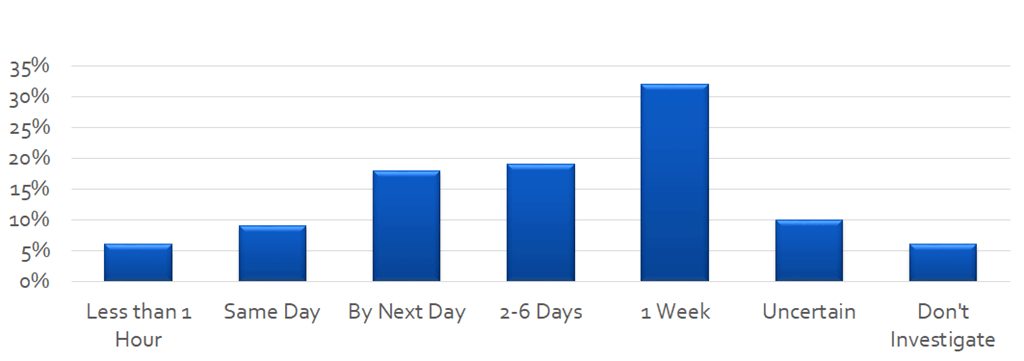
Lastly, we wanted to know how long it takes PPC managers to figure out why they’re off-target, once they’re realized there’s an issue. It affects how quickly they can start to put a fix in place. When this question was asked, there was a caveat of “Consider delays in starting your investigation, not just the work itself. From noticing there is a problem to understanding why you are off target, what is the total time?”
Those who replied with less than 1 hour are impressive. However, 1 hour to same day should be the standard that we all strive for since it’s easy to visualize data.
Issues arose when a client or boss would ask an open ended question like:
- Why is our spend up? Or, why is our spend up by 20%?
- Are conversions seems down?
- Why did our ROAS go up so much last week?
- Why did our clicks drop by half?
It should only take only a few minutes to give an initial answer, but this type of question often would throw the PPC department into chaos. This would then delay other work, as the team ran reports to give an answer.
Is monitoring automated?
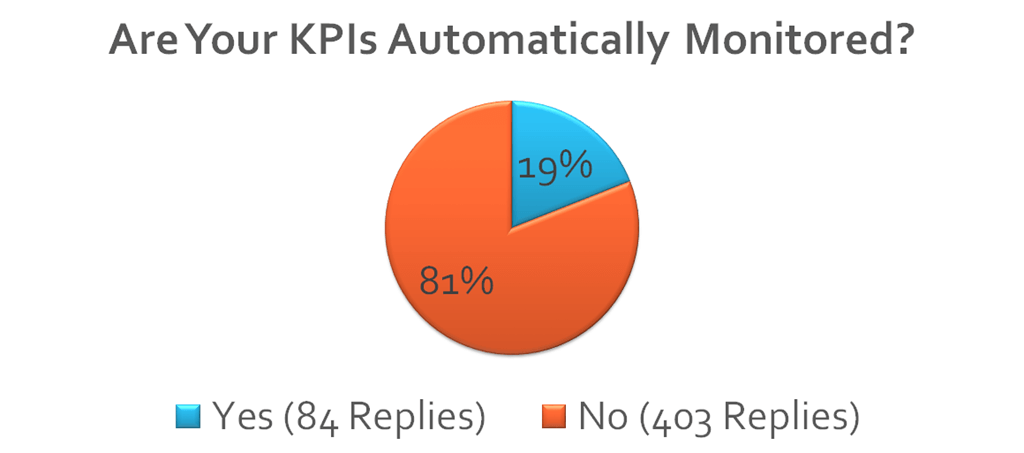
As it’s simple to run KPI monitoring with scripts or tools, we wanted to know how many companies were automating KPI analysis. The answer was low: only 19% of the companies surveyed automate their KPI monitoring.
The answer is automated KPIs with visualized results
While the KPIs you monitor will differ, KPI monitoring should be automated. You can either use a tool like Adalysis to define your KPIs or set up alerts within the PPC platforms or use a script.
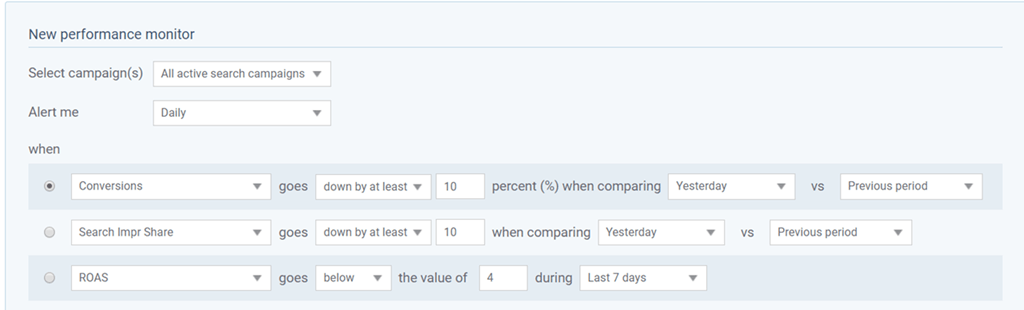
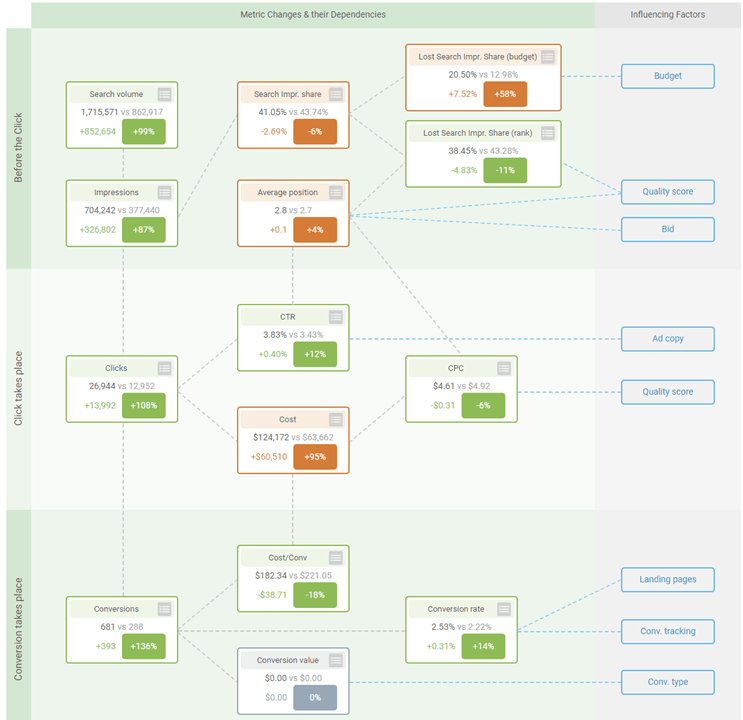
Once you know there’s an issue, you need a quick way to visualize the factors that affect that KPI, like this Looker Studio report (also automated within Adalysis). It shows you how your metrics changed and what influences them.
For instance, this company saw impressions and clicks go up, but conversions dropped. The primary issue was a drop in conversion rate, that drove an increase in CPA. Therefore, in a single glance, we know that we should start digging into exactly where the conversion rate dropped to fix the issue.
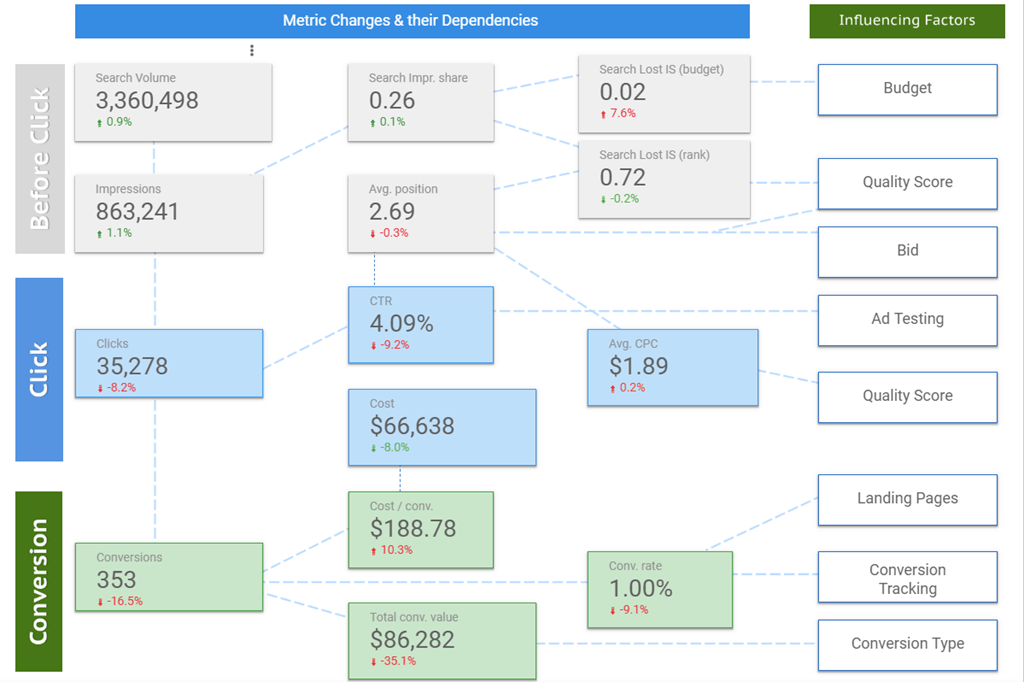
This report has so much data on it that we need to understand what affects search volume, CTR, conversions, and our other metrics. Once we understand all of these metrics, then the investigation can be swift and efficient so you can quickly put a fix into place. Adalysis is built so you can see at a glance what metrics changed and where.
For instance, in this account, it took about 30 minutes to discover the issue:
- Conversion rate dropped
- The drop in conversions came from three campaigns.
- In two of these campaigns, the company was trying broad match to see if they could attract more visitors.
- This is what caused the search volume to increase.
- The broad match keywords were converting worse than their other match types.
- The broad match keywords were also receiving so many clicks that their budget was now constrained (increase in Search Lost IS (budget))
- With a constrained budget, their top converting keywords were showing less often and causing the conversions to drop.
- They paused some broad match keywords and lowered bids on other ones. They added new search terms that were leading to conversions as keywords.
- In the other campaign that dropped in conversions, they found a lot of new search terms they were showing for from their exact match words that didn’t properly describe their business. They carried out an n-gram analysis and switched a lot of their exact match words to phrase match, as well as adding more exact match negatives. This resolved the issues in that campaign.
In total, this took them about one hour on the diagnosis and another two hours for the fixes (primarily due to having to fix all the exact match words Google now thought were relevant). The end result was that the following month was one of their best ever.
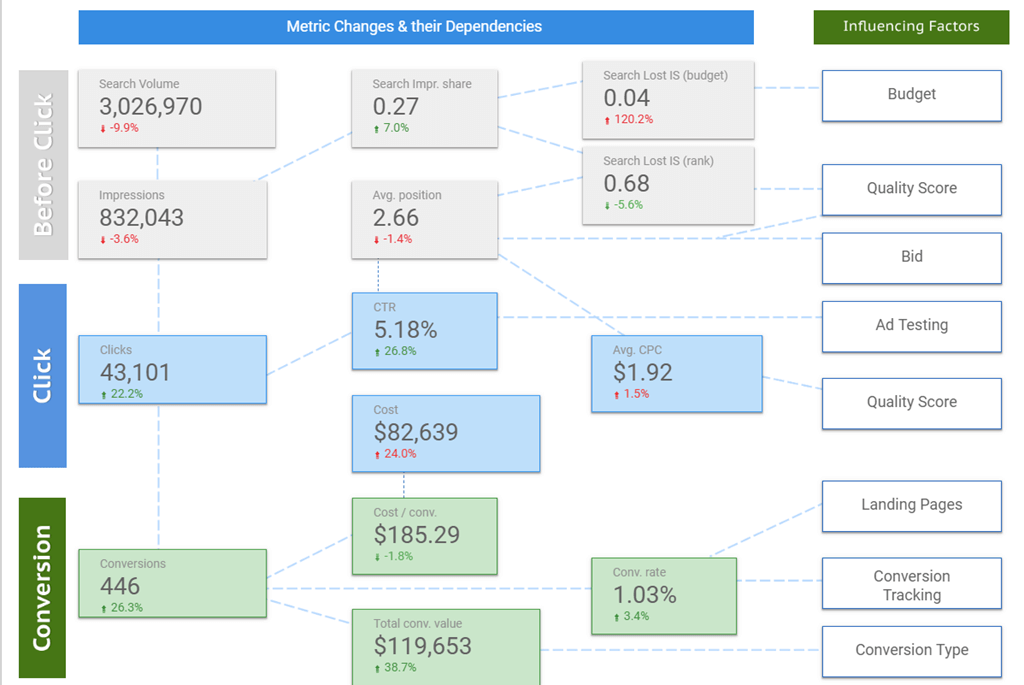
The reason this diagnosis only took an hour is that they had useful tools in place and they knew how all the metrics were related. This means they could easily analyze accounts, campaigns, ad groups and keywords to quickly find the problems for each campaign and put fixes into place.
There is a level of understanding and experience needed to quickly make these decisions. Over the next several weeks, we’ll dig into the metrics in this chart and what data and entities (keywords, audiences, ads, etc.) affect those metrics. Stay tuned.
More information:
Share around the web


Related posts
View all
When to pause exact match and rely on broadmatch instead
When to pause exact match and rely on broad match instead
The hidden challenges of AI Max searchterm reporting
The hidden challenges of AI Max search term reporting


Improve performance
with
actionable
analysis


Leave a comment