A different way to think about ad relevance in quality scores
By Brad | 0 comments July 28, 2016
Categories
Ad relevance makes up 22% of your visible quality score. It can be difficult to work with since it doesn’t always make logical or semantic sense.
For instance, an easy way of thinking about relevance is semantically. If the keywords and overall idea are in the ad, then the ad should be relevant. If the keywords and idea aren’t in the ad, then it’s not relevant.
If you’ve been advertising for a while, you’ve come across many examples where that just doesn’t seem to be true. Now, the most common of these are for ‘related’ or ‘complimentary’ products. For instance, many mortgage companies will advertise on real estate terms. The idea is that if a user is looking to buy a house, they’ll need a mortgage. This creates a new keyword with poor relevance.
Why?
Mortgage is a financial intent search.
Real estate is a location intent search.
An easy way to think about relevance is via the game ‘Taboo’. In that game, a player is given a card, and their goal is to have other users guess what’s on that card without saying a few forbidden words. For instance, if someone says:
- Rate
- Calculator
- 30 year fixed
- 5 year arm
- PMI
- Buying a house
The word being talked about must be mortgages. Those words are semantically related terms.
Relevance within quality score can be thought about from this angle and it often works well. However, algorithms don’t think – they just examine numbers.
For instance, if a user is looking to book a cruise, these two ads seem to be relevant (look at the ideas; not the lines and character limits):
Ad 1:
Book Your Dream Cruise Today
Save 10% by booking online!
Ad 2:
Book Your Dream Cruise Today
Travel to Alaska in Style!
From an algorithm standpoint, what we really have is someone looking for a cruise and two ads that use these components:
Ad 1:
Headline: Call to action
Description: % discount
Ad 2:
Headline: Call to action
Description: Destination
Bing produces and shares many heatmaps. These heatmaps show us the intersection of ideas for headlines and description lines and what that intersection produces from a CTR standpoint. These idea intersections can be thought of as ad relevance.
For instance, when we look at this heatmap and find intersections of these ad ideas, what we see is:
- Ad 1: headline – call to action. Description – % off. Green result – high CTR.
- Ad 2: headline – call to action. Description – destination. Red result – Low CTR.
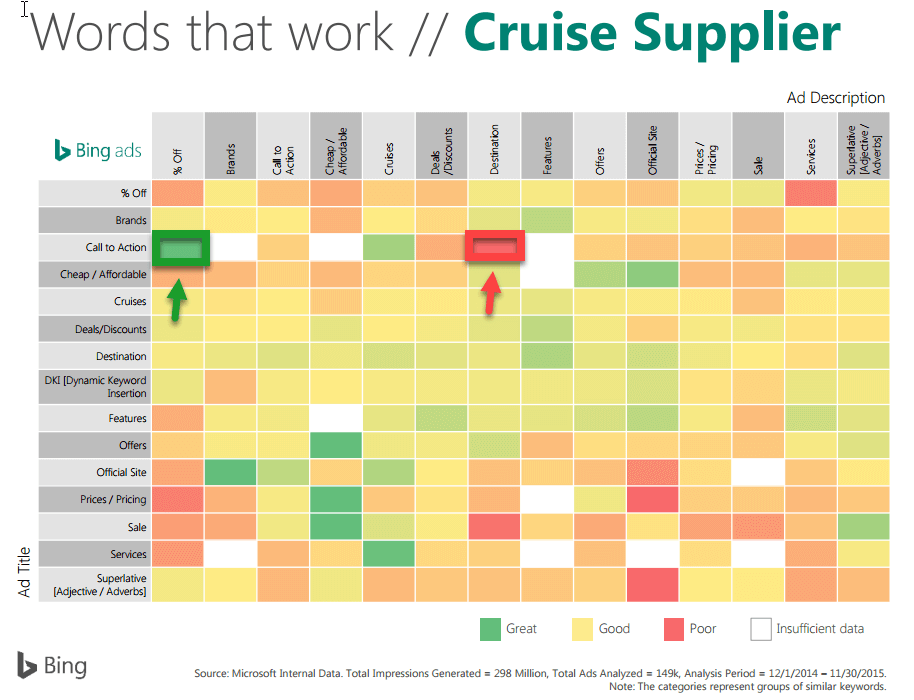
This type of data is aggregated at the industry level. There are many exceptions as averages blend everything together, which is why you should test ads and ideas for yourself.
If you are using multi-ad group testing to receive customer insights, you can easily test your own hypothesis. If you’re looking for an easy way to test these hypothesis, take a look at Adalysis.
However, these heatmaps are great places to get some ad ideas and avoid some major mistakes before you start testing.
Share around the web


Related posts
View all
When to pause exact match and rely on broadmatch instead
When to pause exact match and rely on broad match instead
The hidden challenges of AI Max searchterm reporting
The hidden challenges of AI Max search term reporting




Improve performance
with
actionable
analysis



Leave a comment