Categories
We’re big fans of automation, but not everything should be automated.
There are a few considerations with automation:
- Is the process repeatable & consistent?
- With automation, you’re trusting the system to do the exact same thing over and over without any variation. If you don’t trust all the inputs, then you shouldn’t automate the process.
- An Adalysis example of this is ‘draft ads’, where you automatically replace losing ads with new ads based upon a set of criteria.
- With automation, you’re trusting the system to do the exact same thing over and over without any variation. If you don’t trust all the inputs, then you shouldn’t automate the process.
- Computer/human-assisted automation is where the computer does a set of computations and gives you suggestions, or narrows down a huge list to a list of suggestions. The suggestions aren’t automatically implemented. Instead, they’re given to a human to decide what to do.
- An Adalysis example of this is the ad test results. You’re asking a system to crunch through a huge amount of data and only show you the ad groups where you have test results, where you can take action.
- Alerts are useful if most of them are useful.
- For instance, there was a huge credit card breach at a retailer a few years ago. It wasn’t acted on quickly, as experts said the alert generated hundreds of low-priority false alerts daily.
- If you get so many alerts that you’re just deleting them, you’re causing yourself more work than is useful.
- In the graphic, we say 50%, but that’s a rough guideline. If there are going to be a lot of alerts, then 75% of 90% being useful is a better number.
- An Adalysis example is when you have 0 ads in an ad group, or you aren’t testing certain ad groups. These alerts are always useful.
Here’s our flowchart for determining automation:
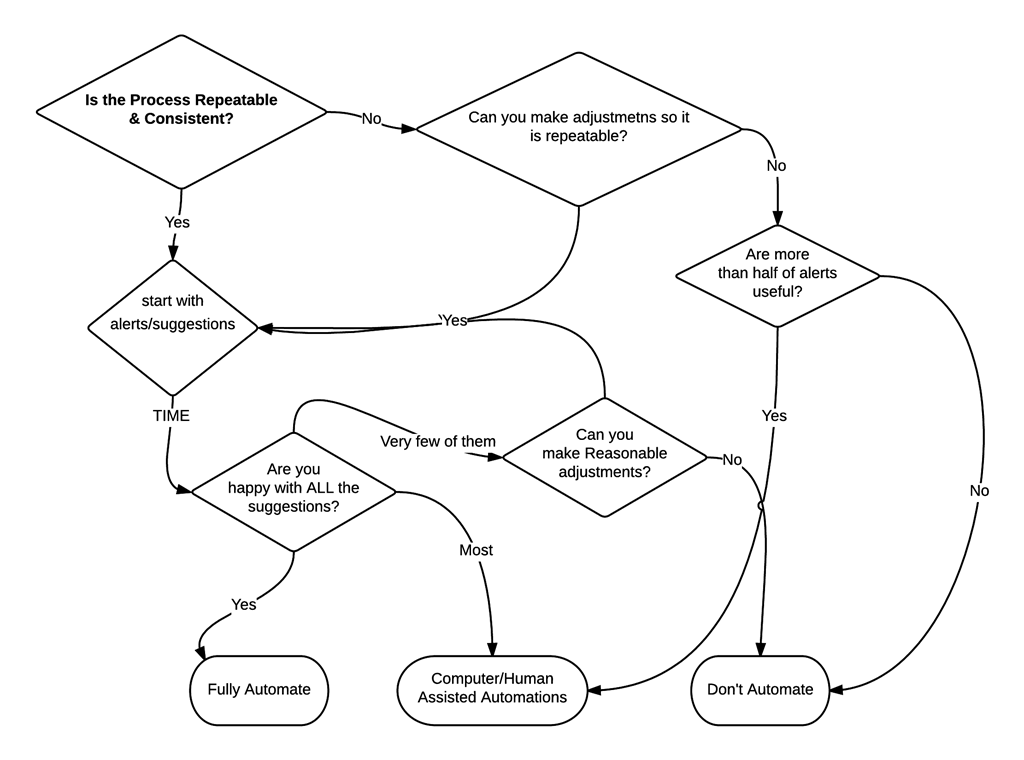
This flowchart was tweeted as I was speaking at SMX and gathered a lot of interest, so I thought we’d show the entire presentation.
Share around the web


Related posts
View all
When to pause exact match and rely on broadmatch instead
When to pause exact match and rely on broad match instead
6 min
The hidden challenges of AI Max searchterm reporting
The hidden challenges of AI Max search term reporting
8 min


Improve performance
with
actionable
analysis


Leave a comment