How broad match can lower your CTR as your Quality Score increases
By Brad | 0 comments April 23, 2019
Categories
When you use broad match, you can show for semantically similar keywords. This means that if you have the keyword laptop, you could show for the search term Alienware Gaming Computer as they are both computers. You could also show for highly related terms such as ultraportable.
Google doesn’t automatically show you for all of these related terms. Your budget and your quality score help determine what queries can trigger your ad to be displayed.
As your budget increases, and you maintain good Quality Scores, your keywords can be triggered by a more varied set of search terms. If you are highly budget-capped, then you might not see many of them.
For instance, if you have the keyword laptop in your account and you have a low budget and a low quality score, you might only show for words like laptop, new laptop, used laptop, and some misspellings. If you have a high quality score, then you can start to show for terms like computer, towers, Samsung computer, and more.
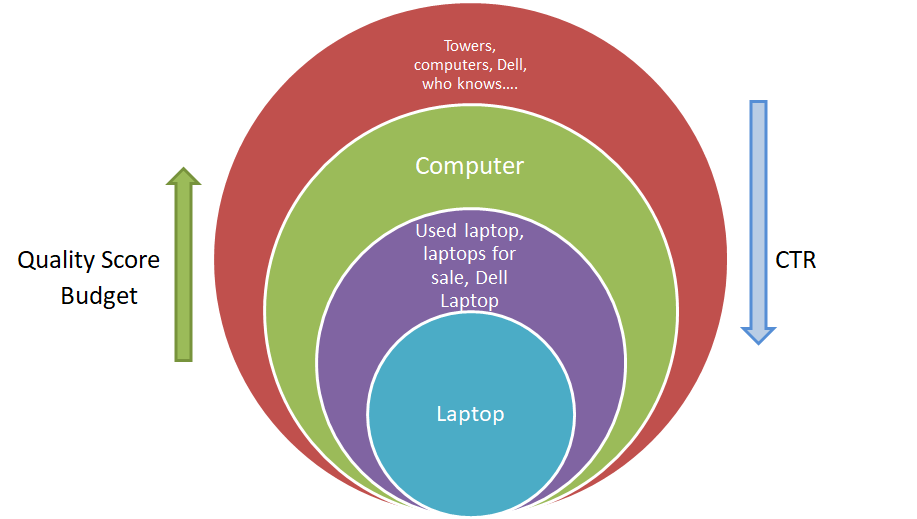
As your keywords show for more queries, your CTR generally starts to drop as many of these terms aren’t closely related to your ad.
As you are getting additional impressions at a low CTR, your ads are often shown on the bottom of the page.
As your ads are shown on the bottom of the page, then your bottom impression share goes up and your top and absolute top impression share decline.
If you make changes and your quality score goes down, then your ads show for fewer of these semi-related queries. At that point in time, your CTR goes back up, you get fewer of these new impressions, and therefore your top impression share and absolute top impression share go up.
This is why when we are graphing our impression shares over time, we often look at campaigns and ad groups where we are not using broad match. This means broad match isn’t polluting our trend insight data. If you are looking to find out how to create these graphs, see this article.
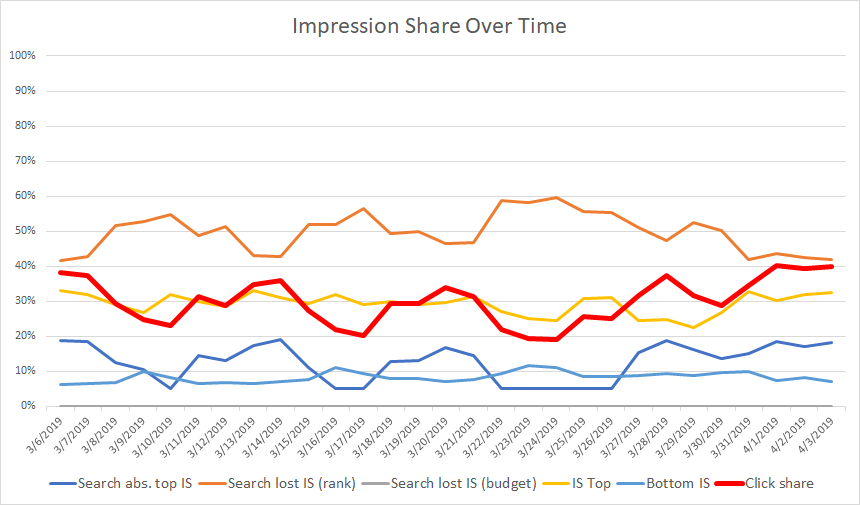
Broad match has a lot of good uses ranging from showing in multi-language queries to capturing a broad spectrum of search terms. However, it’s important to watch the data as broad match keywords can hide deeper trends due to how it can expand and contract your search terms.
Find out more:
Share around the web


Related posts
View all
When to pause exact match and rely on broadmatch instead
When to pause exact match and rely on broad match instead
Search term challengesAl Max
Search term challenges Al Max




Improve performance
with
actionable
analysis



Leave a comment