Categories
Google Ads account management went through a split about five years ago. Old school PPCers managed accounts with tight rules and control. (Relative) newcomers manage accounts based on machine recommendations.
In this talk, we examine the pros and cons of both approaches in the era of AI.
The automation adoption curve
Google’s AI keeps evolving, but new features follow a familiar pattern. They launch with lots of hype and cherry-picked case studies. Early testing prompts a pullback by advertisers. Once Google’s machine learning algorithms collect enough data, performance picks up very quickly.
For example, automated bidding now works well for almost everyone. Display and audiences are reliable for many, and PMax in retail often produces results. However, automatically created assets, unpinned RSAs, and PMax for lead gen are still risky for many accounts. They’re at the pullback stage. AI Max is at the launch stage.
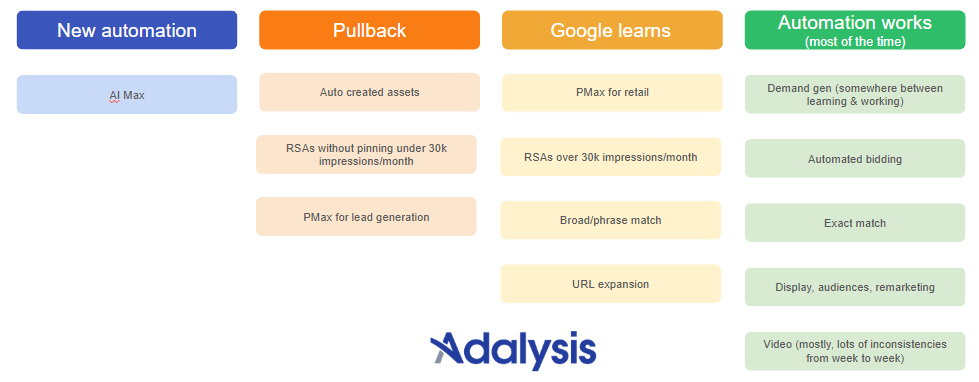
You might have heard of the ‘Google tax’. It refers to spending money on an immature Google product. The thinking goes that the feature is terrible when it launches, but once it has enough good data, it’ll be great — even if that takes a few years. However, paying the Google tax is a choice for PPC managers. Without it, these new features would never work well.
Evolving management styles
Early Google Ads account management focused on task lists and calendars, which ensured everything got done. Newer PPC managers may focus more on recommendations from Google Ads, relying on machine-driven insights to drive their optimization actions.
However, there are some drawbacks to relying on Google’s advice. Let’s look at this budget example. In the first line, it looks like we’ll make $9,000 more in conversion value if we accept the recommendation. However, we have to spend $13.1k to increase our revenue by $9,040. That’s simply not a good recommendation.
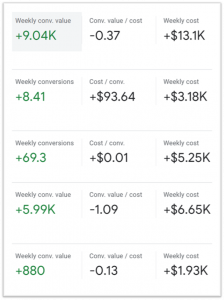
That’s not to say that all Google recommendations are bad. The repairs category is fantastic, for example. Google also doesn’t really tell you what the criteria for their recommendations are.
Instead of arguing in favor of one approach over the other, we’re simply talking about two different management styles:
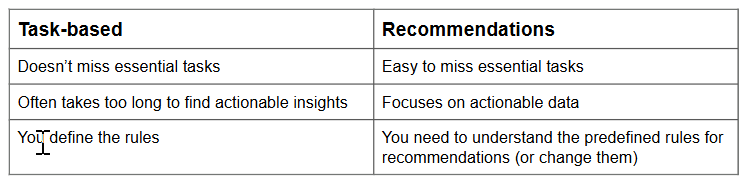
Either way, structure remains the foundation of successful campaigns. This shift in PPC account management means building guardrails, so AI can learn within your framework.
Building your guardrails
Guardrails refer to a way to steer the machine towards your goals by setting limits on how it spends money or serves ads.
Your biggest protection is your campaign structure. Budgets, locations, scheduling, and bid methods all shape how AI learns and executes. Consistency across campaigns is critical. But there isn’t a one-size-fits-all answer.
Take an account with 50 business locations. You could have one campaign, which is easy to manage and accumulates lots of data. However, you can’t change the budget by location or easily run special offers. The right choice depends on the account goals and how you want the automation to work.
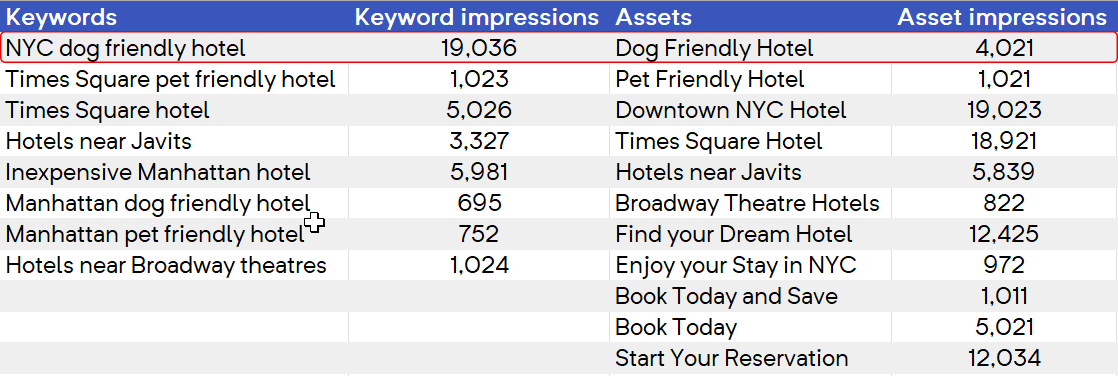
The second guardrail is ad group organization. Every keyword and every asset in an ad group should work together. If some assets are only relevant to part of the group, split them out. This increases relevance, strengthens quality score, and gives AI a clearer framework.
In this example, this hotel’s ad group had a mixture of pet and location-focused keywords along with matching ad headlines. The impression data shows that Google was matching pet keywords with Times Square headlines. Reorganizing resulted in a substantial boost to ad effectiveness.
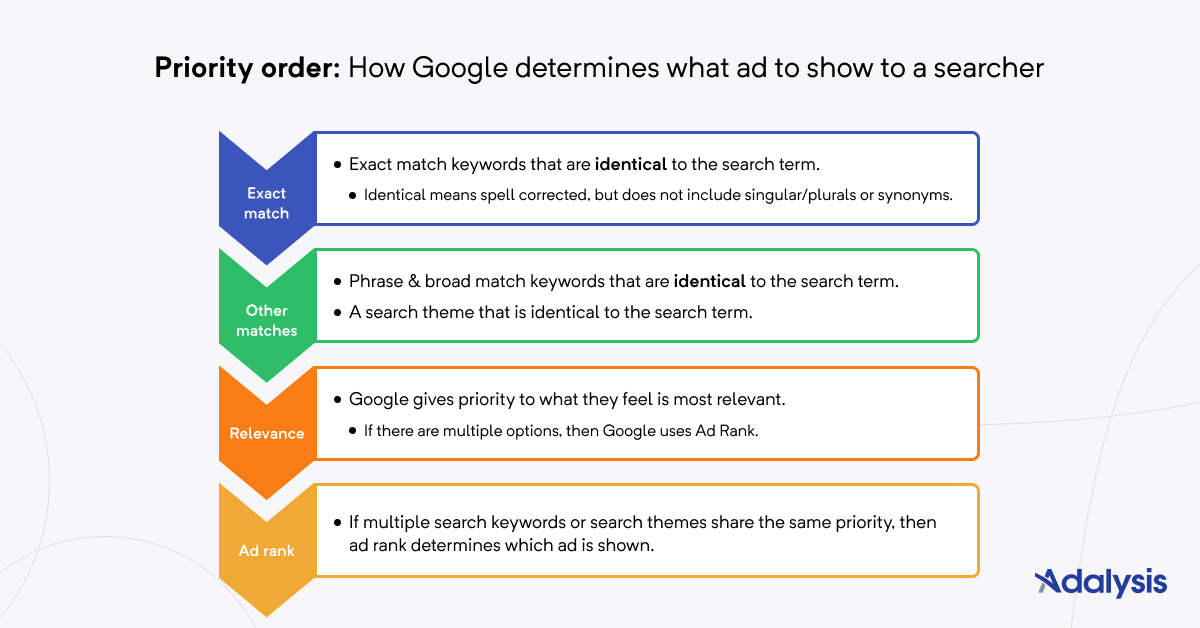
The third guardrail is targeting and bidding. If you’re running multiple campaigns, Google uses a hierarchy system to determine which ad or campaign will be shown. The winner usually comes from your exact match keywords or your most restrictive campaign eligible for the auction (e.g., the one with the lowest budget, the smallest geography, and so on).
PMax bypasses this hierarchy. Google checks for an identical exact match keyword, then an identical phrase or broad keyword. Next, it falls back to what it considers most relevant, and finally, ad rank. When Search wins the search ad slot instead of PMax, conversion rates are significantly higher most of the time. This is why promoting strong search terms to exact match is still essential, especially if you run PMax campaigns. Match types are a good guardrail to ensure the best ad is displayed for any auction.
Match types perform differently with each bid method, so it makes sense to choose your method first. Maximize conversions or Maximize conversion value aim for volume within your budget and will often let CPA or ROAS drift as you scale. Target CPA or Target ROAS try to hold the line and will skip expensive opportunities. As budgets rise, broad and phrase can expand aggressively, which may help or hurt depending on your objective.
Raising data density
Machines need data density to learn. If you have an RSA with 15 headlines and two descriptions, that’s over 47,000 possible combinations. In a low volume ad group, it would take years for Google to determine which asset combinations are best to display to users.
Pinning reduces combinations, so learning speeds up. A practical pattern is to pin a small set of proven lines to headline 1 and headline 2, then decide if headline 3 should be pinned based on whether you want assets to convert into sitelinks. Ignore ad strength as a score, but the “more unique” and “more relevant to keywords” prompts are useful sanity checks.
Take for example a dry cleaner who picks up and delivers for free at your location in New York City. They knew that when these benefits were displayed, their conversion rate was 357% higher than when they weren’t. But those lines aren’t related to the keywords, and Google rarely showed them until the company starting pinning assets. Pinning lets this company define what’s important and lets Google play with the rest.
While pinning reduces ad strength, it doesn’t affect quality score, the ad group’s impressions or your ability to enter the auction. In fact, lower strength ads usually have better conversion rates and click-throughs than higher strength ads. This means you can pin with confidence.
Auditing the machine
Auditing the machine is now a core part of PPC management workflow. But what does it mean?
The machine could be scripts, third-party tools like Adalysis or Google’s recommendations. Auditing the machine means understanding the criteria for an alert, and deciding whether to automate, customize or ignore each one.
It also captures tasks that were really important to marketers 10 years ago and often get ignored by marketers trained with recommendations. The output is your task list of areas to look at more closely (rather than leaving them to the machine).
Use n-grams to surface waste across search terms you would never catch by reading rows. Segment audiences granularly so you can see what deserves more budget, instead of hiding performance inside one large list.
Monitor impression share to decide when to contract hours or regions, and when to expand. Compare “people in” versus “interested in” locations, since commuter behavior often favors the latter. Expect “near me” to convert yet drag down ad relevance and quality score.
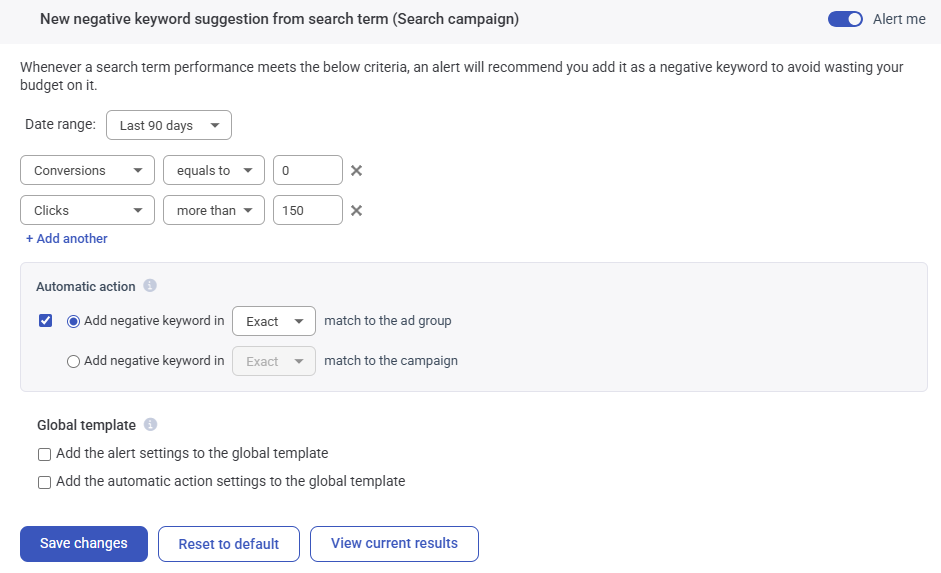
Image: Understanding the rules for your Adalysis audit alerts means you can adjust them for your account’s goals and data volumes.
Wrap-up
Humans still win where data is thin. Prior knowledge and strategic judgment outperform the model when feedback is sparse. Large language models are useful for ideation, grouping, and first-draft copy, but they’re not an autonomous account manager.
The operating model is simple:
- Build for data density and clarity.
- Choose bid methods, then align match types accordingly.
- Define what you always accept from recommendations (automate those), what you never accept (dismiss/modify criteria), and what needs human review.
- Audit the machine on a tight cadence.
- Re-invest time saved into testing and creatives that AI can’t do for you.
At Adalysis, we’re here to support PPC teams with scaling their performance, not their workload. Download these PPC checklists if you’re looking to adapt your daily, weekly, monthly, and/or quarterly reviews for the AI era.
Want structured guardrails and faster audits across PPC accounts? Start a 30-day free trial of Adalysis. No credit card needed.
Share around the web


Related posts
View all
When to pause exact match and rely on broadmatch instead
When to pause exact match and rely on broad match instead
Search term challengesAl Max
Search term challenges Al Max



Improve performance
with
actionable
analysis


The Performance Max campaign is the primary contributor to budget consumption, but it presents challenges in budget allocation across various channels. While Google has started to provide performance reports for different channels, there are still limitations when it comes to controlling spending at the channel level. Advertisers lack the ability to adjust bids for specific devices, which complicates efforts to optimize overall campaign performance. This situation makes it difficult to identify where to increase or decrease budget allocations effectively, leading to potential inefficiencies in ad spending. Companies are seeking more granular control over their budgets to ensure they can allocate resources based on the performance metrics provided by Google’s reports.
Leave a comment